
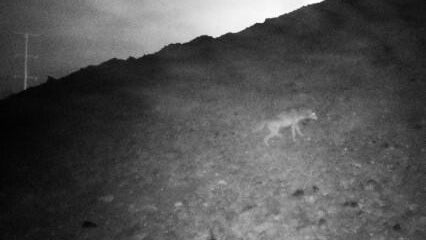
An Oct. 28 photo of a coyote climbing near the Wallis Annenberg Wildlife Crossing is the first of more images to come as remote cameras will document animal movement along the $92 million bridge.
The National Park Service released the coyote's photo on Wednesday and said cameras will be installed this month to study how animals use the structure, which is intended to reconnect wildlife populations separated by the 101 Freeway in Agoura Hills.
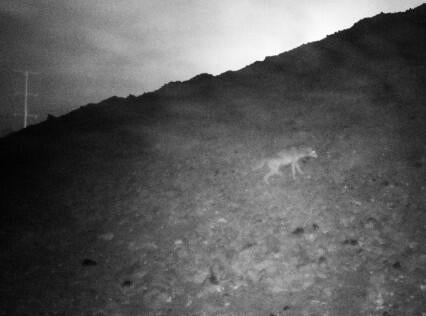
"During recent construction monitoring, park scientists observed bobcats, coyotes, gray foxes, mule deer, and mountain lions regularly using a trail immediately adjacent to the future crossing," the National Park Service wrote in a news release.
Work on the wildlife crossing began in 2022 and is scheduled for completion this December. The 165-foot-wide crossing spans 10 lanes of the 101 Freeway at Liberty Canyon Road and is off-limits to humans; it's for animals only.
Project leaders have said it's more than just a crossing, but a habitat intended to support mountain lions, desert cottontails, lizards, bobcats, deer, bats, monarch butterflies, and dozens of bird species.
The camera installation is part of a broader scientific monitoring program developed by National Park Service biologists, project partners, and other researchers.
"This is more than just about whether animals use the crossing," said Seth Riley, the wildlife branch lead at Santa Monica Mountains National Recreation Area. "We want to understand how effective it is in reconnecting an ecosystem that has been divided by the freeway for decades. That is a much bigger scientific question and answering it will take years."
Park biologists have studied wildlife and habitat fragmentation in the Santa Monica Mountains region since 1996, according to the National Park Service. Research has documented how freeways and urban development impact wildlife movement and gene flow. This work provided the scientific foundation for the crossing.
The Wallis Annenberg Wildlife Crossing is scheduled to officially open to wildlife on Dec. 2, 2026.


